
Control, Safety, and Trust
Off CampusThis thread examines how Tom’s need to control risk meets Reese Anders’s effort to reclaim agency after assault, and how their growing trust depends on boundaries rather than rescue.
increasing Bearing strength in each event
 decreasing
Bearing strength in each eventdecreasingReese’s Defensive Rules
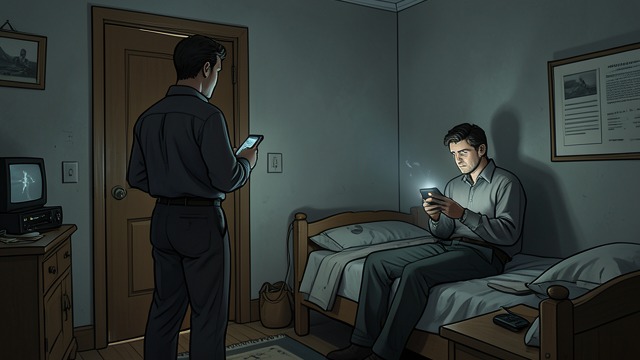
Control as Protection
A room made into a boundary
Reese Anders reacts to Tom’s arrival with alarm and tries to drive him out, using noise and sexual bravado to insist that the room remain his territory. His hostility seems disproportionate until Tom learns that a previous roommate and that roommate’s friends assaulted him.
Rules against helplessness
Reese’s later casual encounters give him a situation he can direct: he chooses the men, sets the limits, and keeps himself in control of the contact. The behavior does not erase the trauma, but it lets him approach intimacy under conditions he can manage.
Tom initially sees the pattern as reckless and wants to intervene. Understanding its function requires him to recognize that control is not simply a quirk or a provocation; it is one of the ways Reese has tried to make his body and room feel like his own again.
Witness Without Taking Over

Listening to a Difficult Truth
A disclosure in the dark
Reese tells Tom what his former roommate and the other students did to him. He explains that he was intoxicated, did not identify everyone involved, and could not provide the evidence the school expected after the fact.
Anger on Reese’s behalf
Tom is furious that Reese still feels concern for the former roommate, who did not stop the assault. He names the roommate’s failure plainly, while Reese asks him not to turn concern into more yelling or force.
The exchange establishes a difference between believing someone and taking control of their response. Tom can acknowledge the harm and remain present, but Reese must retain authority over what he tells, what he does next, and how he defines his own recovery.
The Burn and the Bucket

Care Without Command
Pain makes dependence visible
After a steam burn leaves Tom’s hand and wrist in severe pain, he returns to Perkins House unable to manage ordinary tasks easily. He refuses medical care partly because of the cost, trying to endure the injury alone rather than admit how much help he needs.
Reese offers practical relief
Reese opens the room for cooler air, cleans up Tom’s scattered supplies, and sets his injured hand in a bucket of ice water. He offers a painkiller and stays close, responding to Tom’s actual needs rather than treating his refusal as proof that he is fine.
The scene changes their relationship because care is made concrete and negotiated moment by moment. Tom can accept help while remaining able to speak, choose, and stop; Reese can offer tenderness without demanding disclosure or control in return.
The Practice and Therapy Pact

Mutual Accountability
A comparison that is not a cure
Tom encourages Reese to see a therapist, recognizing that the assault still shapes his habits and fear. Reese points out that Tom has also stopped doing something essential to himself: running, which once brought him focus and pleasure.
A bargain between equals
They agree that Tom will return to practice as Reese begins therapy. The arrangement is playful at first, but it makes a difficult truth impossible to ignore: neither man can demand change from the other while treating his own avoidance as untouchable.
The pact offers accountability without pretending that a promise can heal trauma. Tom runs and Reese starts confronting what happened with professional help, each taking responsibility for his own recovery while providing a reason to keep going.
Boundaries in the First Attempt

Consent as a Shared Practice
Slowing down to make room
As Tom and Reese Anders move from kissing toward more intimate contact, Reese admits that Tom’s size can make him nervous. Tom steps back, changes their positions, and asks what kinds of touch feel acceptable rather than assuming that desire grants permission.
Trust without perfect certainty
Reese gives Tom room to touch him while naming a clear limit: Tom must not hold him down or move his body against his will. Tom listens, and their encounter becomes something they negotiate together instead of a reenactment of Reese’s earlier loss of control.
The moment does not make either man instantly secure. Its importance lies in a different experience of intimacy: boundaries can be spoken, respected, and revised without ending desire. Trust grows through attention, not through a promise that nothing difficult will ever happen.
During the first weeks of sharing a room
After Tom learns about Reese’s assault
On a Sunday evening after Tom is burned by steam
After Reese describes his assault and Tom admits he has stopped running
During Tom and Reese’s first sexual encounter as a couple
